
03
Market wanted outcomes
Clients needed evidence that engagement was translating into meaningful health progress.
From Engagement
to Outcomes.
Building Discover + Smart Recs and shaping My Focus to move a digital wellbeing platform beyond incentive-driven activity toward personalized behavior change and meaningful health progress.
Personify had a rich wellbeing ecosystem. But the platform was very good at measuring what members did and less capable of understanding whether those actions were relevant to what they actually needed.
The problem wasn't a lack of engagement. It was a lack of meaningful engagement.
Rewards could drive members to complete activities primarily for points. Member research also showed that the breadth of content could make relevant experiences hard to find, while the recommendation engine relied on a limited set of largely demographic rules.
At the same time, the market was shifting. Employers increasingly expected wellbeing programs to demonstrate outcomes, not simply participation.
02
Personalization was shallow
Recommendations relied on a narrow set of rules and couldn't learn enough from member behavior.
Business Impact
$11M
Strategic Investment Secured
My Contribution
Product Lead
Product strategy, research, business case, experience framework, cross-functional leadership
Scale
~50
Cross-Functional Contributors
Personify Health
Enterprise
Health & Wellbeing Platform
THE PROBLEM
Engagement wasn't the same as impact.
01
Content felt
buried
Members had access to substantial content and programs, but struggled to find what mattered to them.
THE INSIGHT & STRATEGY
To demonstrate greater value in the market, we needed a clearer throughline from engagement to health outcomes. Our existing model relied heavily on extrinsic motivation: members completed activities to earn incentives, but engagement alone wasn’t evidence that we were improving health.
We reframed the strategy around intrinsic motivation and meaningful intervention—using what we knew about each member to understand their health intentions, strategically connecting them with existing content and programs, and introducing new interventions designed to support measurable health outcomes.
01 · DISCOVER + SMART RECS
Make the ecosystem personally relevant.
Discover + Smart Recs was the first layer of the strategy: move beyond static, siloed discovery and create a recommendation system capable of learning what was relevant to an individual member.
Recommendations could draw on demographics, engagement, participation, behavioral signals and predictive intelligence, then bring experiences from across the platform directly into the member experience.
MEMBER SIGNALS
behavior · engagement · context
DISCOVER + SMART RECS
rules · models · learning
RELEVANT EXPERIENCES
Journeys · habits · challenges · content
Member response — view · accept · dismiss · engage — feeds the next recommendation
Discover answered: “What is this member likely to find relevant?” The bigger opportunity was: “What should we help this member accomplish next?”
02 · MY FOCUS
Turn personalization into a plan for progress.
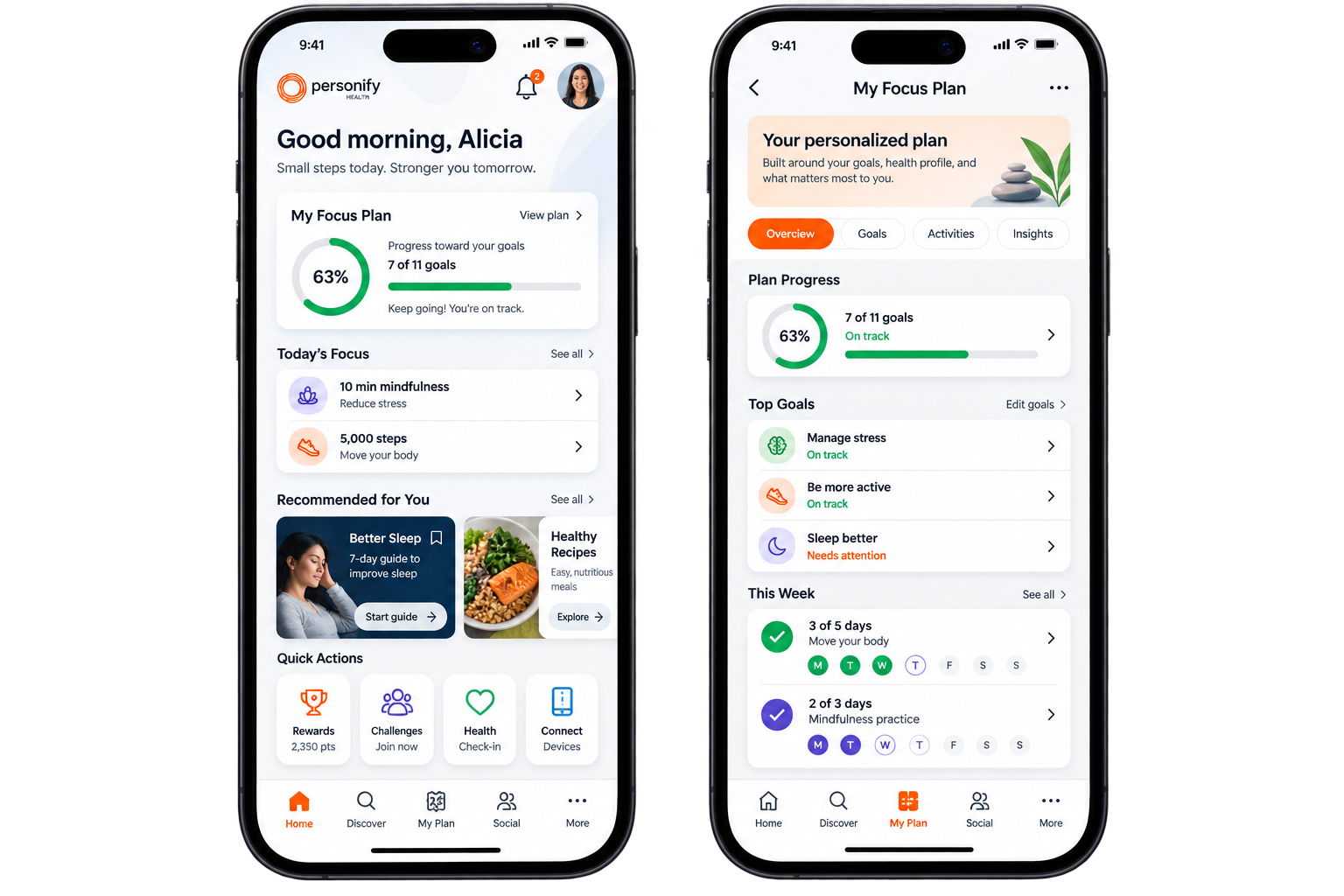
The next step was not simply recommending better content. It was understanding a member's health needs, intentions and readiness well enough to help determine an appropriate next action.
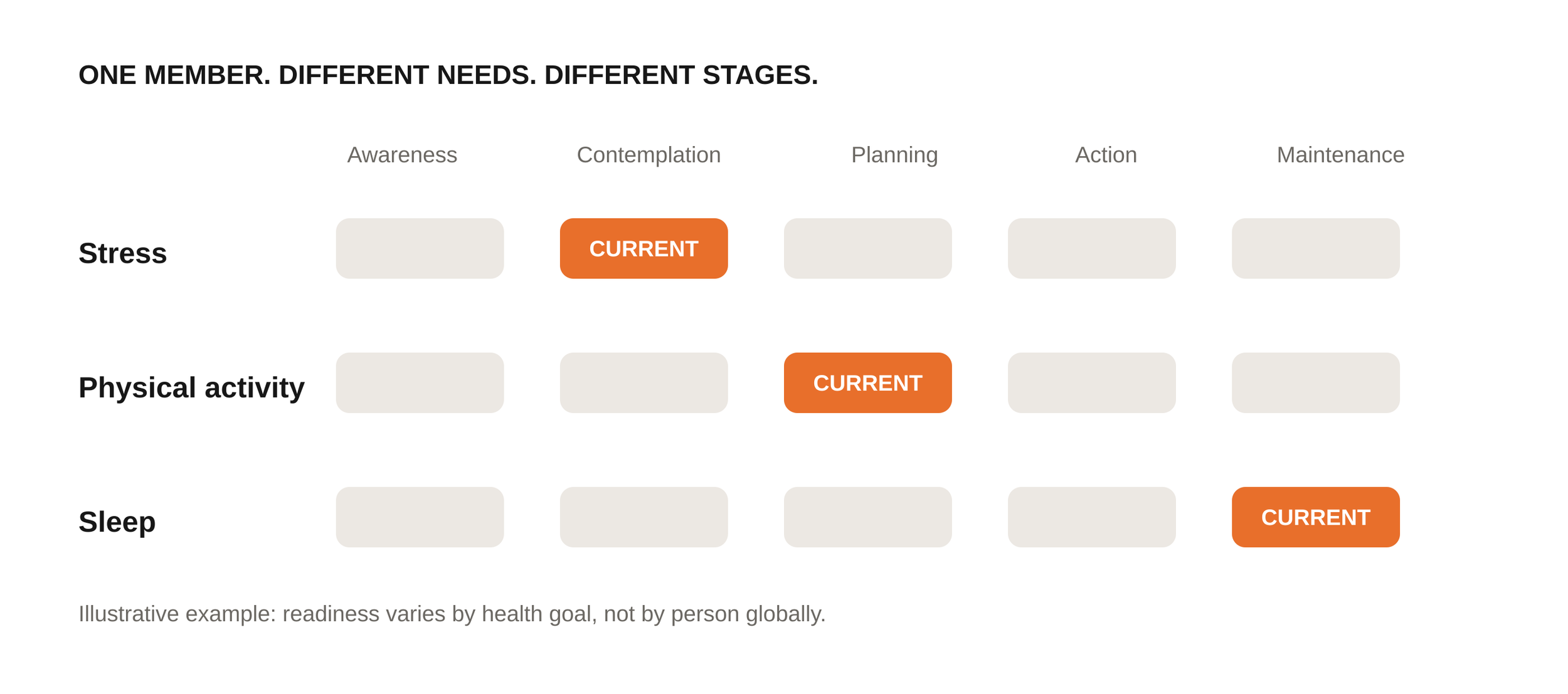
I researched behavior-change frameworks and mapped interventions to stages of change. A critical design insight was that a member doesn't occupy one universal stage: they can be ready to act in one health area and barely contemplating change in another.
03 THE ADAPTIVE MODEL
Meet the member where they are. Then adapt.
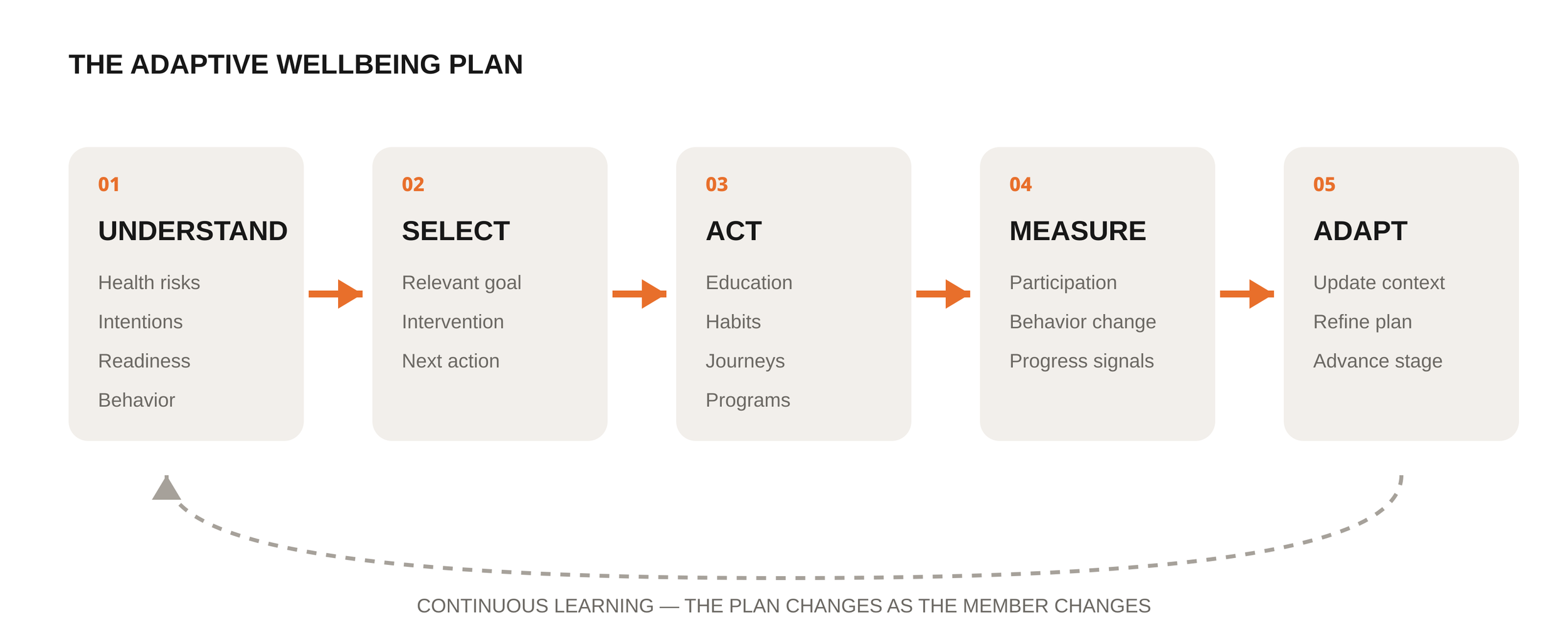
We used a combination of existing behavior change models to create a personalized model specific for the Personify Health digital health and wellbeing platform. The model pulled in behavior change principles focusing on stages of change, self-efficacy, health belief, principles of progress, and assessing barriers. The model also combined other data sources such as health risk, knowledge, engagement, connected data and predictive intelligence.
To show correlation of engagement of our platform to improving health outcomes, we also pulled in clinical information for each of the wellbeing and health risk conditions we supported. With each of these health and wellbeing topics, we mapped clinical guidelines, biometric target data, behavioral targets, and care gaps. These care guidelines were brought into the Personalized Wellbeing Plans as “interventions.” We also pulled in our legacy wellbeing content that mapped to appropriate actions or interventions that the member is most willing to complete and appropriate based on their stage of change. All this data, content, and interventions together was combined to construct Personalized Wellbeing Plans.
02 RETHINKING INCENTIVES
Reward progress, not just completion.
A simple outcomes-based reward system creates its own inequity: people who begin healthy have an easier path to success than people starting with greater health risks.
We couldn't simply reward health. We needed to recognize meaningful progress.
That shifted the conceptual model from
complete activity → earn points
toward
take an appropriate action → make progress → adapt the plan → advance toward an outcome.
Incentives encode product values.
People optimize for what a system rewards. Incentive design is product design.
We started with an engagement problem. We ended up rethinking how a digital health platform could understand an individual, determine what might help next, measure meaningful progress and adapt over time.
LEADERSHIP & SCALE
$11M
Strategic investment
An idea this broad couldn't belong to one product team.
I led the work from market and member research through the product framework and business case, then partnered across UX, Architecture, Engineering, partner teams and nearly every product manager in the organization.
Roughly 50 contributors participated in defining the experiences, signals, data model and integrations required to make the strategy possible. The resulting business case secured an $11M strategic investment.
PUBLIC PRODUCT EVOLUTION
The strategy continues to evolve.
Personify's current public materials describe Discover Catalog and SmartRecs as providing targeted recommendations using interests, goals, biometrics, conditions and predictive risk. The company also publicly identifies MyFocus personalized plans as part of its PercyIQ-powered roadmap.
PRODUCT PERSPECTIVE
What I took forward.
Engagement is a signal. It isn't an outcome.
A completed activity says little about value without relevance and context.
Behavior change isn't linear.
Readiness varies by individual for countless reasons. Product models need to preserve that complexity rather than flatten it.
Personalization is bigger than recommendations.
The better question isn't only what someone will click. It's what could actually help them now.