
Scaling a Digital Pharmacy Through Better Product Decisions
Thesis
Building the Product System to Scale a Digital Pharmacy
Epiq Scripts was acquiring clients faster than its pharmacy operations and product organization could scale. I rebuilt the roadmap around the operational constraints limiting capacity while establishing the Product Management and Product Operations practices needed to support growth.
Project snapshot
Company: Epiq Scripts
Role: Vice President of Product
Scope: Digital pharmacy platform, pharmacy workflows, dispensing, shipping, client experience
My contribution: Product vision and strategy, roadmap prioritization, product operations, UX, instrumentation, AI strategy
Scale: Product and UX leadership across a scaling digital pharmacy
Outcome: 65% improvement in pharmacy operational efficiency within two launch cycles
The problem
Growth was outpacing pharmacy operations
Epiq Scripts was scaling rapidly and onboarding new clients every week, but pharmacy operations weren't equipped to absorb that growth. The business had an objective of reaching capacity for 10,000 prescriptions per day while processing fewer than 10,000 per week at the time.
As fill volume increased, friction became increasingly visible across pharmacy workflows: redundant work, disorganized processes, manual intervention, and opportunities for error. Product requests competed for limited Engineering capacity, but roadmap decisions weren't consistently tied to the operational constraints most likely to prevent the business from scaling.
Product lacked the infrastructure to measure value
From a Product Operations perspective, there was limited instrumentation connecting releases to adoption, workflow performance, operational efficiency, revenue impact, or go-to-market activity.
That made it difficult to answer one of the most important questions Product needed to answer:
Which problems are actually worth solving first?
Product and Engineering lacked clear operating boundaries
The Product–Engineering working model also needed clearer governance. Product, UX, Engineering, Operations, and Commercial lacked consistent mechanisms for discovery, prioritization, decision-making, and launch planning.
Most critically, Engineering was independently developing new user-facing capabilities without Product involvement. In at least one instance, this created compliance risk in a highly regulated pharmacy environment.
Scaling the business therefore required more than improving individual workflows. We needed to improve both the product and the system responsible for building it.
The insight & strategy
I treated pharmacy operations as a product system. If Epiq Scripts was going to move from fewer than 10,000 prescriptions per week toward capacity for 10,000 per day, the roadmap had to address the constraints preventing the entire system from scaling.
Rather than starting with a list of requested features, I used operational data, workflow observation, and input from pharmacy teams to understand where work accumulated, where errors occurred, and where employees were compensating for limitations in the existing tools.
That reframed prioritization around leverage:
Where could Product remove the greatest operational burden, reduce risk, and create capacity for growth?
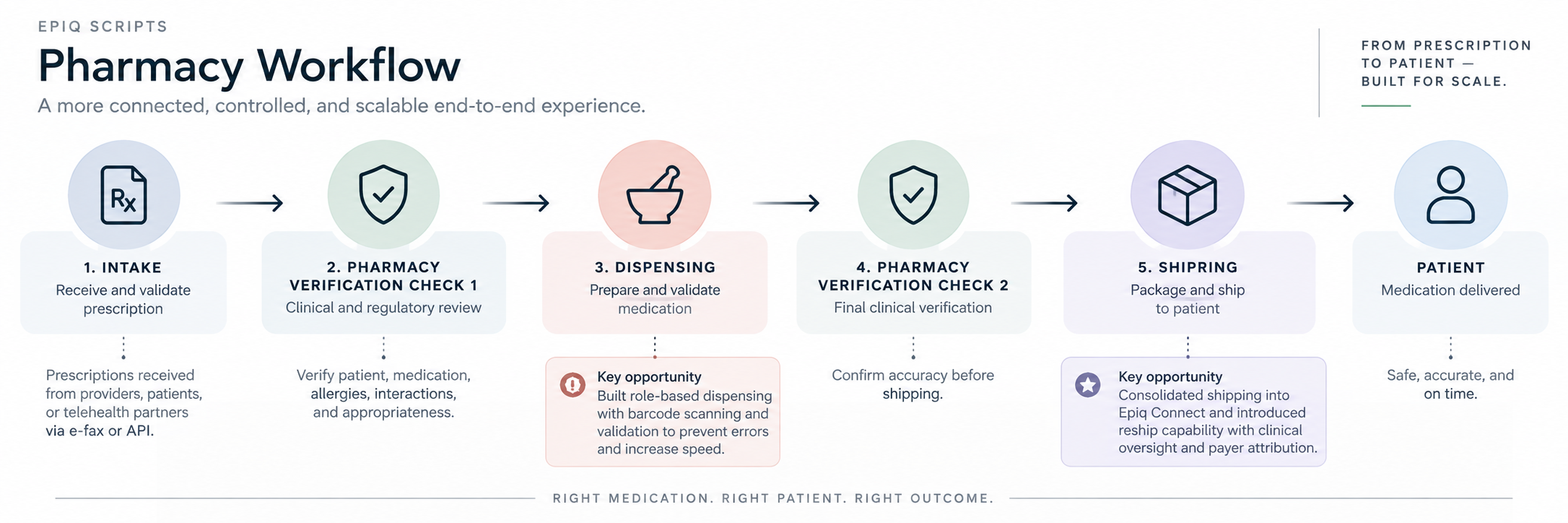
Dispensing and Shipping emerged as two of the highest-leverage opportunities inside the pharmacy workflow, with significant friction, delays, and opportunities for error.
But following the system also exposed constraints beyond the pharmacy itself. Accounting, for example, required a multi-person team to manually assemble invoices across three systems while accounting for client-specific pricing that existing applications couldn't support. A process that took days at the current volume would become increasingly unsustainable as the client base grew.
These findings became the basis for a roadmap organized around business constraints and measurable outcomes rather than feature requests.
What I built & led
01 PRODUCT STRATEGY & MANAGEMENT
Changed how the organization decided what to build.
I established structured discovery and prioritization across Product, UX, Engineering, and Operations, shifting the roadmap away from feature requests and toward the operational constraints, customer needs, and business objectives that mattered most to scale.
I introduced clearer expectations for discovery, requirements, UX involvement, prioritization, validation, and post-launch measurement. I also established clearer ownership between Product and Engineering: user-facing capabilities required Product ownership and the appropriate operational, clinical, and technical review, while Engineering-led infrastructure work had greater visibility across teams.
This created a roadmap where investment could be evaluated against a common question: What will create the most leverage for the business and the people using the product?
02 PLATFORM & WORKFLOW TRANSFORMATION
Moved critical operations into Epiq Connect and redesigned them for scale.
Mapping the pharmacy and business workflows exposed several high-leverage opportunities where fragmented systems, manual work, errors, and missing business rules were limiting the company's ability to grow.
Rather than simply migrate existing processes into Epiq Connect, we used the transition to rethink how those workflows should operate.
DISPENSING
Preventing errors at the point of work
Dispensing relied heavily on BestRx, required significant manual data entry, and supported bulk dispensing—a workflow we identified as a contributor to pharmacy dispensing errors.
We built a role-based dispensing capability in Epiq Connect accessible only to pharmacists and pharmacy technicians. Configurable dispensing stations could be organized by client, medication, or non-medication products, giving Pharmacy Operations greater control over how work moved through the facility.
More importantly, we designed validation directly into the dispensing workflow. Pharmacy staff scanned both the prescription and product labels, and Epiq Connect validated the patient and medication match before allowing the prescription to advance.
A mismatch stopped the workflow and alerted the pharmacy technician to correct the issue before continuing.
By designing error prevention into the point of dispensing, we reduced reliance on downstream detection and rework while consolidating work into a single system. The dispensing workflow was a major contributor to the 65% improvement in pharmacy operational efficiency achieved through the first two launch cycles.
SHIPPING & RESHIPPING
Preserving clinical oversight while creating cost accountability
Shipping was already being migrated into Epiq Connect when I joined, replacing workflows spread across BestRx and a custom third-party legacy system that required an ongoing maintenance fee. I inherited that work and helped expand the capability to address a significant gap: reshipping.
Medications required reshipment for many reasons. Sometimes Epiq Scripts was responsible because of a dispensing or shipping error. Other times a patient, provider, or telehealth client requested a cancellation or address change after the original shipment had already been processed. Without a mechanism to distinguish responsibility, Epiq Scripts absorbed the cost of every reship.
We designed a reship capability that allowed the Dispensing team to initiate a reship, identify the responsible payer, and route the prescription back through the appropriate pharmacy workflow. This gave the business a way to recover costs when another party was responsible, with hundreds of dollars in projected monthly savings.
The work also corrected a more consequential workflow issue. Engineering had independently developed a reship capability that placed initiation with the Shipping team. Because reshipping medication required clinical oversight, that approach bypassed an important pharmacy control and created compliance risk.
I prioritized and expedited the Product-led workflow so that reships followed the appropriate clinical process while also solving the underlying operational and financial problem.
PRICING & BILLING
Turning commercial complexity into configurable platform logic
Accounting was generating invoices using Epiq Connect, BestRX, QuickBooks, and multiple spreadsheets. Teams manually reconciled product pricing, client-specific contracts, promotional rates, packaging costs, and fulfillment charges—a process that required multiple people and could take days to complete.
Instead of simply automating invoice generation, we addressed the pricing complexity underneath it. We rebuilt Epiq Connect's global pricing capability to provide an accurate, configurable source for product pricing that authorized Operations leaders could maintain. We then introduced client-level pricing that supported contracted and promotional rates and applied those rules accurately at the client and prescription level.
We also created configurable rules for costs that were previously difficult to consistently capture, including special packaging and fulfillment variables such as shipping carrier and cold-pack requirements. This allowed Epiq Scripts to appropriately charge clients for services that created additional cost to the business.
Once a client was configured with the appropriate pricing, contract, packaging, fulfillment, and billing rules, Epiq Connect could apply those rules to transactions and automatically generate invoices according to the client's billing schedule. This shifted invoicing from a multi-system, spreadsheet-heavy reconciliation process toward a scalable platform capability, and gave Commercial clearer parameters for the pricing flexibility the product could support.
03 PRODUCT OPERATIONS
Built the operating infrastructure needed to make better product decisions repeatedly.
Scaling the platform required more than improving individual workflows. Epiq Scripts also needed a consistent way to connect strategy, delivery, launch, and measurement.
I established Product Operations practices that created greater structure and visibility across the product lifecycle, including:
Planning & prioritization: evaluating opportunities against business objectives, customer and operational needs, risk, impact, and available capacity.
Product instrumentation: connecting releases to adoption, workflow performance, operational efficiency, and revenue impact.
Release management: creating greater visibility into what was shipping, why it mattered, dependencies across teams, and how success would be evaluated.
Go-to-market coordination: improving the handshake between Product, Operations, Commercial, and other teams responsible for bringing new capabilities to customers.
Product–Engineering governance: establishing clearer ownership, decision rights, communication expectations, and visibility into work across both organizations.
The purpose wasn't to add process. It was to create enough structure for Product and Engineering to make faster, better decisions as the company grew—and to know whether those decisions were actually creating value.
Critical product decisions
The highest-leverage decisions weren’t always about what to build. Several were about what the workflow needed to protect as we made it faster and more scalable.
Don’t recreate a broken workflow
Moving dispensing from BestRx into Epiq Connect gave us an opportunity to rethink the workflow rather than simply reproduce it in a new platform.
Bulk dispensing was efficient in theory, but our analysis identified it as a contributor to dispensing errors and downstream rework. We designed the new experience with role-based access and barcode validation that required the medication, prescription, and patient to match before an order could advance.
The goal was to increase throughput without trading accuracy for speed.
Preserve clinical controls
Reshipping initially looked like a straightforward operational capability, but the workflow carried clinical implications. An Engineering-led solution placed reship initiation with the Shipping team, bypassing the clinical oversight required before medication could be dispensed again.
I prioritized the Product-led workflow, placing initiation with Dispensing and routing the prescription back through the appropriate pharmacy process.
It reinforced an important principle for the broader Product–Engineering operating model: user-facing healthcare workflows need the right clinical, operational, product, and technical perspectives involved before they are built.
Build business rules into the platform
The accounting team's invoicing problem couldn't be solved sustainably by making manual reconciliation faster. Pricing logic was fragmented across systems, spreadsheets, contracts, and institutional knowledge.
We moved those rules upstream into Epiq Connect, creating configurable product, client, packaging, and fulfillment pricing that could be applied at the prescription level and ultimately drive automated invoicing.
That also created clearer boundaries for Commercial: the platform could support flexibility without requiring Operations and Accounting to reconstruct every client agreement downstream.
Apply technology according to risk
As part of the broader product strategy, I evaluated where AI could meaningfully reduce repetitive operational work and where the risk profile required more deterministic controls and human judgment.
In higher-risk clinical workflows, including drug utilization review, I deliberately kept AI out of the decision path when established safeguards and pharmacist judgment were more appropriate.
Technology choice followed the problem, the evidence, and the consequences of getting it wrong.
Leadership & scale
As VP of Product, my responsibility extended beyond defining the roadmap. Epiq Scripts was adding clients quickly while its pharmacy operations, platform, and ways of working were still evolving. Product needed to help the organization scale without becoming another constraint on growth.
I worked across Product, UX, Engineering, Pharmacy Operations, Accounting, Commercial, and executive leadership to connect business objectives to the operational problems limiting capacity and translate those problems into product investment decisions.
Within Product, I coached Product Managers toward stronger discovery, prioritization, and product judgment and introduced clearer expectations for how opportunities moved from problem identification through development, launch, and measurement.
Across Product and Engineering, I established clearer ownership and decision rights, particularly for user-facing capabilities where operational, clinical, regulatory, and UX considerations needed to inform the solution alongside technical requirements.
I also partnered with Commercial and executive leadership on client needs, product value, pricing and SKU strategy, vendor and build-vs-buy decisions, and investment priorities.
The goal was to build a Product organization and operating model capable of scaling alongside the pharmacy.
Outcomes
The first two launch cycles demonstrated that focusing the roadmap on operational constraints could materially change the pharmacy's ability to scale.
65%
Improvement in Pharmacy Operational Efficiency
Workflow improvements increased operational efficiency within the first two launch cycles, expanding the pharmacy’s capacity to support continued growth.
Major contributor: redesigned dispensing workflow
ERROR PREVENTION
Errors stopped upstream
Barcode validation prevented medication and patient mismatches from advancing through the dispensing workflow.
COST ACCOUNTABILITY
Reship Costs Assigned at the Source
Payer attribution created a path to hundreds in projected monthly savings on reships.
AUTOMATED BILLING
From Reconciliation to Automation
Configurable pricing and fulfillment rules enabled invoices to generate automatically by client billing schedule.
What I took forward
Operational constraints are often product problems hiding in plain sight.
The roadmap became much clearer once I stopped looking at individual feature requests and started looking at the system behind them: where work accumulated, where errors originated, where people compensated for limitations in the tools, and where business rules lived outside the product.
That experience reinforced something I’ve carried into every role since: understand the workflow before designing the solution. The highest-leverage product decisions often come from fixing the underlying system—building the right controls, moving complexity upstream, and designing around the realities of how people actually work.
And in healthcare, efficiency only matters when it preserves the things the system needs to protect: accuracy, clinical judgment, compliance, and trust.
PRODUCT OPERATIONS
From Requests to Measurable Outcomes
Discovery, prioritization, release practices, and instrumentation connected product investment to operational and business performance.