
Modernizing a Clinical Quality Platform
Thesis
Rebuilding the strategy and technical foundation of an underinvested clinical platform.
At Interpreta, I re-established the product direction for an enterprise clinical-quality platform while leading modernization that generated approximately $1.2M in annual infrastructure savings and helped increase delivery throughput 125%.
Project snapshot
Company: Centene / Interpreta
Role: Product Manager, Enterprise Clinical Platform
Product: Clinical Actions
Scope: Payer and clinical data, HEDIS care gaps, clinical-quality workflows, AWS infrastructure
My contribution: Product strategy, roadmap, clinical/data requirements, platform modernization, cross-functional delivery
Scale: Medicaid, Medicare, and Marketplace populations; 10-person delivery team
Headline outcome: $1.2M annual infrastructure savings + 125% increase in throughput
The problem
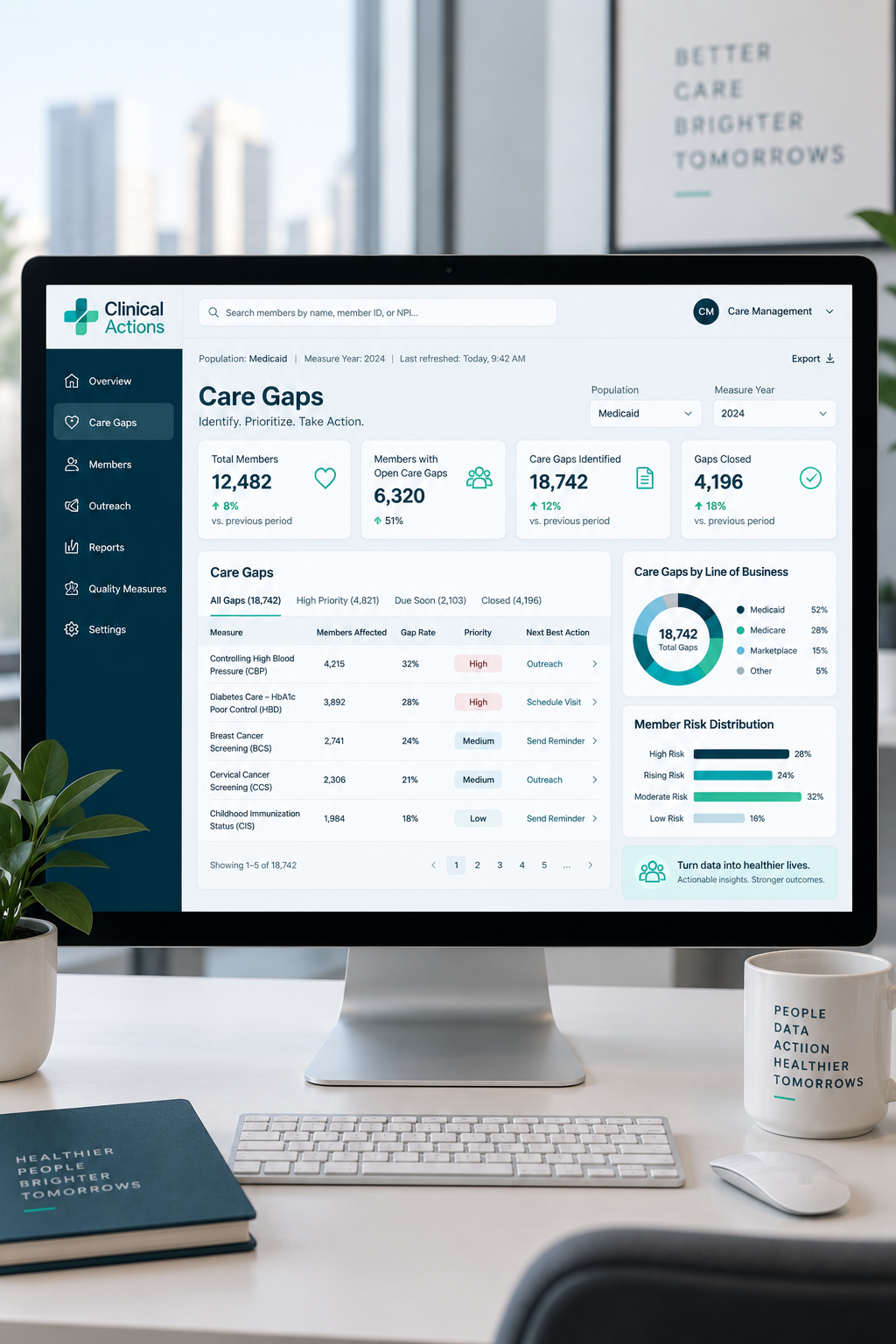
Clinical Actions ingested payer claims and clinical data to identify actionable care gaps against certified HEDIS measures.
But the platform had experienced more than three years of limited investment.
That created three interconnected problems.
The product needed a renewed strategic direction. The architecture needed to scale more efficiently. And the team still had to respond to changing HEDIS measures and clinical protocols while modernization was underway.
Standing still wasn't really an option in a product whose underlying clinical requirements continued to change.
The insight / strategy
I reframed modernization as a product investment rather than an infrastructure project.
Architecture affected cost, scalability, delivery speed, and our ability to support future clinical-quality use cases.
So the roadmap needed to address the product and platform together: restore strategic direction while removing the technical constraints limiting what the product could become.
What I built / led
I re-established the product vision and roadmap for Clinical Actions and translated payer, clinical, regulatory, and data requirements into product capabilities.
I worked with clinical and technical partners to support ongoing care-gap identification across Medicaid, Medicare, and Marketplace populations while leading the transition toward a multi-cluster AWS architecture.
I also improved prioritization, requirements clarity, and execution practices across the 10-person cross-functional delivery team.
Critical product decisions
Modernization couldn't come at the expense of the clinical product already in market.
Annual HEDIS and clinical protocol changes continued regardless of the architectural work happening underneath them.
That meant sequencing modernization alongside ongoing product obligations rather than treating it as a clean rebuild.
The architecture also had to justify itself economically. Scalability mattered, but infrastructure investment needed to produce measurable business value as well.
Leadership & scale
I worked across clinical, payer, data, regulatory, and Engineering stakeholders whose priorities weren't always naturally aligned.
Re-establishing the roadmap meant restoring confidence in where the product was headed while creating enough execution discipline to move both modernization and ongoing clinical requirements forward.
Across the 10-person cross-functional team, clearer priorities and requirements helped substantially improve delivery throughput.
Outcomes
The transition to multi-cluster AWS architecture generated approximately $1.2 million in annual infrastructure savings while improving scalability.
Improved prioritization, requirements clarity, and execution increased team throughput 125%.
The platform also regained a defined roadmap for continued clinical-quality use cases.
What I took forward
Architecture becomes a product concern when it changes the economics or possibilities of the product.
Some of the most consequential product decisions never appear in the UI. Product leaders still need to understand them well enough to connect technical investment to customer value, business economics, and future capability.